Showing posts with label Science. Show all posts

Friday, February 9, 2018

Celebrating Light in Grade 2 Enrichment

How does light travel?
How does light interact with other objects?

These are the questions that we investigated in our science study into light in second grade enrichment.  In our first meeting, students came into a dark enrichment space, and were challenged to think about light.  It is all around us, yet we found that we had not spent much time thinking about its properties.  If students closed their eyes, could they feel when a flashlight was shone on them?  What are some sources of light? What questions do we have about light?  We had a great discussion and then spent the rest of class using flashlights to develop observations and questions.  

Next we used our great science thinking to consider sources of light.  Students created tables to compare objects that produced light, and ones that did not.  I observed many great discussions as students considered what light really is.  

Next we investigated how light travels.  We used questions, observations, and careful note taking to share our results. 

Lastly, we studied various materials and how light interacts with them.  We tested many materials and discovered through investigation that  depending on the type of material light will interact differently. This realization led us to an engineering problem in which students had to select the best material to design a bike helmet.  Students used experiments to test out their hypothesis and did a great job showing and sharing their thinking.

Last week we wrapped our unit with a 'celebration of light'.  We made our own flashlights with LEDs and batteries and we built light mazes and forts.  Second graders learned a lot about light and did a great job connecting real life ideas and problems to their discoveries.


Science Fair Resources

The science fair is coming! On Thursday March 15th RES students in grades K-4 are invited to come and share their great science fair projects with our community.  The science fair is a great way for students and families to work together to explore and learn about topics that interest them.


Entry forms will be sent home Friday February 9th and will be due back by Friday February 23rd.
Open ...

Not sure where to get started?  I highly recommend starting with your interests! Is there a topic you studied in school that you would like to learn more about? Is there something you have always wondered about--maybe how it works?  Do you have a special collection you would like to share?

The RES science fair is a non judged family event...which means adult help is welcome and appreciated..AND kids can work together to create projects too!

Not sure where to get started? Here are a few resources!

I love this website. It has tons of great project ideas and even lets you answer a survey to narrow down the choices to your interests!
http://www.sciencebuddies.org/

This site also has great examples, and includes some great videos which will support visual learners too! Although they are also a business trying to sell science materials, it includes many great free resources in the 'Experiments' section:
http://www.stevespanglerscience.com/lab/experiments/

And one more of my favorites!
https://sciencebob.com/category/science-fair-ideas/

In addition, the RES school  library is full of science project ideas and resources.  Did you know you can check out additional books with a family account?  See Mrs. Redford to set this up.

And lastly, I have several science project idea books, and am happy to discuss and brainstorm ideas with kids or families....just stop by and see me, OR email me to set up some time.

Happy Experimenting, Discovering and Learning!
Have FUN!

RES Science Fair--COMING SOON! SAVE THE DATE! CREATE A PROJECT!


RES SCIENCE FAIR
Thursday March 15th, 2018
Students in Grades K- 4 will be sharing their great science projects in the RES gym!  The Farm to School program will be offering a dinner during the event so that both participating families and those looking for a night out can grab a great meal!   Raffle prizes will be awarded to students who ask great science questions! Everyone is welcome!
RES Farm to School Dinner
Time: 5-6:30pm
Location: RES Cafeteria
SIgn Up To Help Us Meal Plan at:  https://goo.gl/forms/nqQ6ReYT4s3s0Eu92

RES Science Fair
Time: 5:45 – 6:45 pm
(participants may set up projects any time after 5:15pm)
Location: RES Gym

Tuesday, October 3, 2017

An Amazing Learning Extension!

Last year in fourth grade students participated in a combined library and enrichment class in which they were supported in developing research questions based on their own interests, finding the answers to those questions and then developing a project to share what they learned.  The process we used with students is documented on this blog:  https://thinkcreatecollaborate.blogspot.com/

The work that students completed during this capstone process is always amazing and unique because it is really driven by their own interests.

Last year one student decided to work on the question:  How do we remember things?
http://images.all-free-download.com/images/graphiclarge/human_brain_picture_165499.jpg

It turned out that this was a question that his sister and he had been discussing at home and that she had submitted to a podcast show for young learners called Tumble Podcast http://www.sciencepodcastforkids.com/.   He thought that instead of waiting for their response he would find the answer and create his own podcast!  His work was great and at the end of the school year he had completed his podcast:
https://www.youtube.com/watch?v=iZMQUN1hP2o

His podcast was shared with our school learning community at an in person celebration and posted online. Normally this would be the end of the capstone process as students move to the middle school for Grade5!

But in this case, the exciting part is that at the same time the Tumble Podcast had also decided to explore this question. They created their own podcast with the input from expert scientists...BUT they also included our RES students' work as well (his family had shared his work with the podcast producers!)
Here is the completed Tumble Podcast with our RES student featured!
https://art19.com/shows/tumble/episodes/a7e1b749-9440-49b9-b26b-589b78f4b067

When students pursue their interests their learning is always amazing, but this extension beyond the classroom adds to the idea that we build knowledge as a community of learners -- within our school community but also with the support of family members and experts.  I love playing just a small role in a students' learning journey as they navigate their interests and new knowledge.  As a teacher I believe that it is important to support student interests. Each student is the reason I became a teacher, and this connection to the real world is a reminder to me of how we all play a role in the education of our kids. It is inspiring to see how students have the same questions that other adults pursue as careers over a lifetime.  I am so lucky to learn next to such amazing, thoughtful students!

Friday, May 12, 2017

Tomatosphere Resources

Second Graders!

Check out this link to find awesome information about our Tomatosphere project and space exploration!
http://tomatosphere.letstalkscience.ca/Resources/Library.aspx

Thursday, March 23, 2017

RES Ambassadors of STEM

A few months ago I blogged about an opportunity that Richmond Elementary School was part of through a grant from the Vermont After School Program and Montshire Science Museum. That Tinkering Grant award allowed us to have some awesome materials for engineering exploration both in school and in an after school class that I hosted.  The relationship that RES established with the Vermont After School program has led to excellent learning for students as well as professional development for myself as the RES enrichment teacher. It also led us to an opportunity to visit the Vermont State House in Montpelier last week and talk to state representatives about all of the great engineering activities, and the amazing makers and scientists that we have at RES.

I was proud to bring six students to Montpelier to participate in a day that included engineering design challenges, a visit to floor of the State House (where our Richmond representative called out our students by name!) and time to engage representatives in making through our RES marble maze display (Students designed elements and created on the spot).

It was great to share about the importance of STEM (Science, Technology, Engineering and Math)---and to see RES students SHINE!  At RES this year we are on a journey to bring making, creating and engineering to all students through the creation of a Makerspace.  It is a journey as we figure out how this work fits into our curriculum as well as our after school programming.  Connecting to the Vermont After School program has been an excellent way to engage in dialog about how we can provide multiple avenues for all students to access these skills and opportunities.


If you have ideas about this topic--I would love to hear from you. This journey is a collaborative one that invites all of us to think about how to provide awesome opportunities for our kids!

Tuesday, March 21, 2017

RES 17th Annual Science Fair Success!

Last Thursday evening over one hundred people gathered at Richmond Elementary School to celebrate science and learning!  The RES Family Science Fair is a tradition at our school that brings family and friends together to share their learning.  There are no awards, or winners......just students learning and sharing and excited about all of the great and amazing concepts that science brings to life.  Each year I am inspired by students--the extra work they do and the depth of their thinking is awesome!  This year we had a large range of projects. The below video is an attempt to capture some of their great work.


Thursday, February 16, 2017

Science Fair Resources

The science fair is coming! On Thursday March 16th RES students in grades K-4 are invited to come and share their great science fair projects with our community.  The science fair is a great way for students and families to work together to explore and learn about topics that interest them.


Entry forms will be sent home Friday February17th and will be due back by Friday March 10th.
Open ...

Not sure where to get started?  I highly recommend starting with your interests! Is there a topic you studied in school that you would like to learn more about? Is there something you have always wondered about--maybe how it works?  Do you have a special collection you would like to share?

The RES science fair is a non judged family event...which means adult help is welcome and appreciated..AND kids can work together to create projects too!

Not sure where to get started? Here are a few resources!

I love this website. It has tons of great project ideas and even lets you answer a survey to narrow down the choices to your interests!
http://www.sciencebuddies.org/

This site also has great examples, and includes some great videos which will support visual learners too! Although they are also a business trying to sell science materials, it includes many great free resources in the 'Experiments' section:
http://www.stevespanglerscience.com/lab/experiments/

And one more of my favorites!
https://sciencebob.com/category/science-fair-ideas/

In addition, the RES school  library is full of science project ideas and resources.  Did you know you can check out additional books with a family account?  See Mrs. Redford to set this up.

And lastly, I have several science project idea books, and am happy to discuss and brainstorm ideas with kids or families....just stop by and see me, OR email me to set up some time.

Happy Experimenting, Discovering and Learning!
Have FUN!

Tuesday, January 3, 2017

RES Family Science Fair--Save the Date!


The RES Enrichment Program is excited to announce the annual
    FAMILY SCIENCE FAIR  !COMING SOON!
Thursday March 16th, 2017  


We look forward to the excellent projects presented by students in grades K-4!  Please mark your calendars and start thinking about how you would like to participate.

Do you have a science fair project in mind?  Here are some ways to make a plan:
  •   Expand upon an interesting topic you have studied in class
  •  Think about a topic that interests you, or a science question that you are curious about
  • Talk to family and friends to brainstorm ideas for a project
  •  Stop by the enrichment room and borrow a fair idea book and talk with Mrs. Rankin
  • Check out science project resources in the library  (Did you know that your family can check out additional books from the library beyond your weekly two? See Mrs. Redford if you would like to take advantage of this!)


The RES Science Fair is a non-judged family event.  Students are encouraged to work together with family and friends to develop a project they are proud of presenting to our community.  Your entry does not have to be a science experiment. It may be as simple as a display of your leaf collection or as complex as an experiment on how the circulatory system works.  Look at the world around you. What are you curious about? What interests you?  Ask why something is the way it is. Do experiments, demonstrate a scientific principle, make observations of the world around you, or collect and analyze data. 
                            
Most importantly- be creative and HAVE FUN!

In a few weeks Science Fair entry forms will be sent home.  At that time you will be asked to share your planned science fair topic as well as any special display requirements you have. 

Questions? Contact: Darcie Rankin, Enrichment Teacher by email at darcie.rankin@cesuvt.org

Monday, April 4, 2016

Tomatoes in Space?!

This year students from Richmond Elementary School are participating in the TomatoSphere project in third grade to connect with their interdependence science unit.  This is an amazing opportunity to participate in a real citizen science project. Last Friday we planted our blind study seeds as well as made predictions as to which seeds would yield the best tomato plants.  Over the next few weeks we will watch and record our findings.

Here is information about this project as described on the TomatoSphere website http://tomatosphere.org :
____________________________________________________
What is Tomatosphere™?
Chris Hadfield
Tomatosphere™ uses the excitement of space exploration to teach the skills and processes of scientific experimentation and inquiry. Students investigate the effects of the space environment on the growth of food that will inevitably support long-term human space travel.
Pictured above is NASA Astronaut Scott Kelly with 600,000 Tomatosphere™ seeds. These space-faring seeds will be distributed to about 18,000 classes in Canada and the US during the 2015-16 school year. The seeds were launched to the International Space Station (ISS) on board SpaceX’s Dragon on April 14, 2015 and will return to Earth after spending 5 weeks in space.

What does the program involve?

Each classroom is sent two packages of tomato seeds. One package contains seeds that have been sent into space or treated in space-simulated conditions. The other package will contain "control" seeds, which have not been in space. Through the Tomatosphere™ project, students will learn how to conduct a scientific experiment and compare the germination rates of the two groups of seeds. Tomatosphere™ relies on a "blind test" in which educators and students will not know which of the two packages are the "space" seeds and which are control seeds until the germination process is complete and results have been submitted.Watching these seeds germinate and grow will encourage classroom dialogue about the elements of life that support the requirements for space missions:- food, water, oxygen and the need to consume carbon dioxide exhaled by astronauts. Traveling to and from Mars could take more than two years, therefore it is vital to know how to grow food while astronauts make the journey to the Red Planet, spend time on Mars and make the return journey back to Earth.
The results from your Tomatosphere™ science experiments will help Canadian scientists understand some of the issues related to long-term space travel. It’s an out-of-this-world opportunity for your students!

Why grow tomatoes in space?

Tomatoes are practical and valuable plants for space applications. They provide wholesome nourishment, as well as purified water through evaporation from their leaves.
____________________________________________


All the seeds are planted! One tray for each Grade 3 class

Tiny precious experimental seeds and careful scientists at work!

Students predicting which seeds will grow the most tomatoes

Thinking about ensuring this is a fair experiment

Friday, April 1, 2016

Engineering Design

In third grade enrichment this year our classroom activities have been fairly well synched to the work students are doing in their regular classroom.  Our work has focused on enhancing and adding to the science and social studies curriculum.  However for the last four weeks, we left this lock step and students have been spending time in enrichment experiencing the engineering design cycle.  Time in the enrichment classroom is often spent making and creating, but for this challenge I wanted students to have a larger purpose.  Accordingly to the Engineering is Elementary website (http://www.eie.org/overview/engineering-design-process) in order to experience an engineering design cycle, students must ask, imagine, plan, create, and improve.  

Ask--What is the problem?  
We began our engineering design cycle by asking the question: What bugs you?  After we clarified that siblings did not count (!) and that students had to think about things in their daily life, or community or world problems that bothered them..the ideas began to flow! Each student began with an Inventor's journal in which they wrote down their 'bugs'. This was an odd experience for us...spending a large chunk of time just documenting negative things.....but we discussed the idea that often great inventions are born from necessity or the desire to improve something.  Many students wanted to jump right into creating, but to honor the design cycle we spent one class period simply asking questions.  I encourage you to talk to students about what bugged them.  The lists were thoughtful and interesting. Some students focused on one particular issue and spent time thinking about the constraints and how others have approached fixing the problem, while others listed many ideas!  Since students had just completed a persuasive essay, I encouraged them to try to think of physical things that they could manipulate, design or change.  A very few students really struggled to think of any issue that they felt worth working on and so they brainstormed with myself or a partner. (Can you imagine if nothing bugged you?  I think that sounds nice, so could not find fault in that feeling if they truly meant it!) 

Imagine- What are some solutions?  Brainstorm and pick your best idea!
On the second day students read back through their problems.  Some added a new problem they had thought of since our last meeting too.  Then the creative process began.  Some drew pictures, others wrote down ideas, some talked to a classmate or me.  Students added an idea or ideas to their Inventor's Journal of how they would solve their problem.

Plan- Draw a diagram and make lists of materials you will need.
Before leaving our class on the second day, students had to create a materials list. They let me know what they might need to build a prototype.

Create-  Follow your plan and create a prototype.  Test it out.
Last week students began building their prototypes.  We had many successes and many failures.  We learned that sometimes  making something is harder than imagining how to make it! 

Improve- What works? What doesn't? What could you do better?
We are finding that improving and creating are happening all together as students iterate on ideas as they complete their prototypes.

By next week our goal is to have a working prototype that students can bring home to share with families.  I also challenged students to think of a name for their invention!


As we wrap up, stay tuned for a video of their awesome prototype inventions!


Friday, March 18, 2016

Elementary Science Fair Design and Implementation

For the last six years one of my roles as the Richmond Elementary School enrichment teacher is to organize and host our annual science fair.  I have done quite a bit of research into the different types of fairs and how they are run.  Taking my cues from our previous enrichment teacher I continued the RES tradition of making the fair a non judged family event as I looked into ways to increase student engagement, attendance and learning.  I read about problems that other schools had experienced and tried to figure out ways to avoid what seemed to be common complaints, including:  competition between kids and families to have the best project, students not spending time sharing their project, unclear expectations, a disconnect between school and this extra activity and exclusiveness of attendees ( limited by financial and home support).

Although every large school event has challenges, I am very proud of the RES science fair. I will continue to modify the fair to support our students and attempt to increase learning and fun for everyone....but I thought it was also worth summarizing some of my strategies and tools that have worked and not worked so far!  

Positives:

Science Fair Passports:
I have created a science fair passport.  Every student that attends the fair can work on completing a passport.  The passport has six locations.  When a student asks a student with a project a good science question, the science fair participant can give them a stamp (I use markers that kids return at the end of the night and students decide the design of their stamp from a circle to a smiley face!)
Science fair participants are asked to be at their project for at least half the evening,but this is not hard to achieve once you add the passports because they have a job to do....they have to answer science questions!  The high value in this passport system is that it encourages excellent conversations between students!   They take their job of asking and answering questions seriously and do it without adult supervision.  Last week I witnessed second graders talking about a solar system project.  As I listened from the background the two figured out how long it took for Earth to rotate and revolve.  AND they figured it out through collaboration and critical thinking (the student project had just named and created each planet with a single fact about each one).
To encourage passport participation I purchase several science 'prizes' that are raffled off with passport entries at the end of the evening.

Non Judged, Family Event
Although some elementary science fairs are competitive and encourage individual independent student projects..the RES science fair expectations are clearly set as being an opportunity to share our passions and learning.  I also encourage students to work together, and to work with their families.    

Each student who attend the fair gets a participation certificate, their name in the program for the event, and I usually get them each a small token (pencil, badge, isn't snow packets, etc).

Event Date
I set the date of the science fair at the beginning of the year.  I publish it on the school calendar.  I broadcast the date to our school community(parents and teachers) multiple times well in advance of the fair...including blog posts and fliers home.  I send out information and ideas about what a science fair project might look like and provide links to previous fairs as well as ideas and resources.
Setting up this event on a consistent date allows for everyone to plan accordingly.  Families can fit the project making in when it is convenientfor them. 

Making Classroom Connections  
 Some years teachers incorporate the fair into the curricular learning and it provides a great opportunity for students to share their in class projects.  Last year the entire third grade shared their light up animals as a culminating activity for their electricity unit.  In years past we have also hi lighted inventions and energy projects.
I also request that classroom teachers give students homework passes for the time they are working on their project.  This gives families more time to work on the project and helps to support the fair. Classroom teachers have been very supportive of this idea and have even had students bring their projects and ideas to class to share outside of the fair!

Encouraging Families Without Projects to Attend
Over the last few years one of my biggest goals is to attract families to attend, even if they did not complete a project.  This encouragement has really built a sense of excitement..as well as a lack of pressure for those families that want to participate but could not find the time to create a project. We have doubled our non project families!  

Need Improvement:

Adding Additional Aspects Beyond our School Participants 
We have invited our middle school technology group to share some of their learning at fairs. This has been a bit challenging as the timeline does not always fit in with their schedule and so lining up a fit has not yet proven successful.  My first year I invited a local engineer to put on an electricity demonstration.  It was well received and very exciting, but in discussions afterward, the engineer and I agreed that it took time away from student time at their own projects...which should be the focus of this event.

School Support for Project Creation
I have offered after school classes leading up to the science fair to support students creating projects for the fair.  This was a great strategy for including more students and increasing the number of students who did not have support at home to complete a project...but changes to the after school programming, my own personal schedule, and cost became prohibitive.  When we did this program it involved volunteers and my own time and we met once a week for an hour and a half for three weeks.  This was plenty of time to create a meaningful project with twenty students.  We continue to offer financial support for families who would like to participate in the fair through our school activities scholarship program.  

Encouraging Attendance
For several years one of the passport prizes at the fair was getting to pie myself, or our principal in the face!  This was a big hit with many students and families, but some families expressed concern that it was taking away from the point of the fair.  Although I think it just added to the fun, I removed it this year, with no negative consequences to attendance and passport participation.

Future Work:
I would like to continue to increase attendance at the fair.  I would also like to invite some community guests to witness the brilliance of our kiddos!  


Do you have ideas about how to make a science fair great?  Have you participated in the RES science fair, and have feedback?  If so I would love to hear from you.  I am also happy to share any of the resources I have created, from fliers to passports and programs....so if you are a teacher trying to start a fair in your school....feel free to email me!

Thursday, February 25, 2016

Talking Robots Share our Learning

At the beginning of the electricity unit, third grade students spent time in enrichment building 2D or 3D robots with a variety of recycled materials.  The only guideline was that students be creative, and think about where they might want to later light up the robot!  Creativity and imagination was evident as students built robots that had specific jobs (a refrigerator, a generator, and more!), robots that focused on design elements (fabric skirts, hats and hair), robots that resembled something in real life (hamburgers, vacuum cleaners, well known robots), robots that were 3D (some even had wheels that moved!).... just name a few!


Once the robots were created, we put them on a shelf for a while as we deepened our understanding of what electricity is and how it works. Students had opportunities to explore a variety of materials--including squishy circuits, Little Bits and Snap Circuits (exploration started in the enrichment classroom and then extended to maker spaces in each classroom). This exploration was coupled with classroom instruction and electricity labs.

With all of this great learning under their belts, students were ready to go back to their robots and build a circuit that would light them up!  Students had to use their learning about electricity to do this task...but at the same time it was fun and creative! I was so happy to see the joy students had in working on an assessment of their knowledge.  The assessment was meaningful and important to them, and it also allowed teachers to do a check in on student understanding and clear up any misconceptions or confusions!

For the last two classes, students in third grade enrichment have spent time designing circuits and lighting up robots! Once students had a lighted robot, they created a short video clip using an iPad application called Chatterpix.  This is a fun app that can make any picture you take (in this case of their robot) talk with your own voice.  Here is a video compilation of the robots sharing their electricity learning and favorite moments from our unit. Enjoy!

Tuesday, February 16, 2016

Science Fair Resources

The science fair is coming! On Thursday March 10th RES students in grades K-4 are invited to come and share their great science fair projects with our community.  The science fair is a great way for students and families to work together to explore and learn about topics that interest them.

Not sure where to get started?  I highly recommend starting with your interests! Is there a topic you studied in school that you would like to learn more about? Is there something you have always wondered about--maybe how it works?  Do you have a special collection you would like to share?

The RES science fair is a non judged family event...which means adult help is welcome and appreciated..AND kids can work together to create projects too!

Not sure where to get started? Here are a few resources!

I love this website. It has tons of great project ideas and even lets you answer a survey to narrow down the choices to your interests!
http://www.sciencebuddies.org/

This site also has great examples, and includes some great videos which will support visual learners too! Although they are also a business trying to sell science materials, it includes many great free resources in the 'Experiments' section:
http://www.stevespanglerscience.com/lab/experiments/

And one more of my favorites!
https://sciencebob.com/category/science-fair-ideas/

In addition, the RES school  library is full of science project ideas and resources.  Did you know you can check out additional books with a family account?  See Mrs. Redford to set this up.

And lastly, I have several science project idea books, and am happy to discuss and brainstorm ideas with kids or families....just stop by and see me, OR email me to set up some time!

The science fair is always a highlight of my teaching year, and I look forward to seeing the projects that you all create.   Happy Experimenting, Discovering and Learning!
Have FUN!


Friday, January 22, 2016

SNAP Circuits and Little Bits

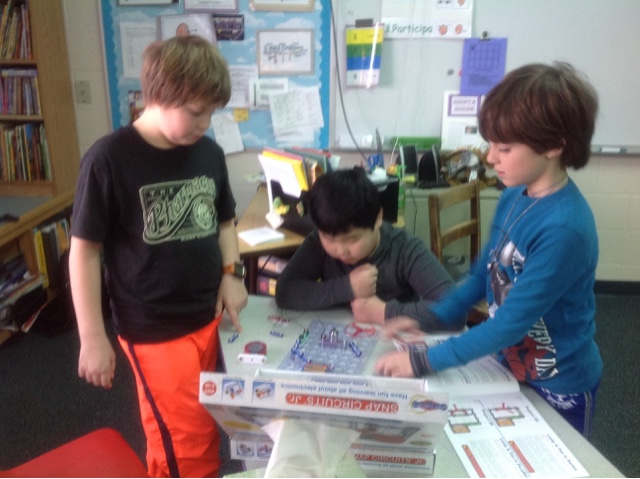
One goal of the third grade electricity curriculum is for students to have the opportunity to explore electricity and how it can power a variety of objects from motors to lights and more.  In the enrichment room we have been using SNAP Circuits and Little Bits to reinforce our understanding of electrical circuits.  These tools are a great way for students to develop their knowledge through exploratory learning-- it is collaborative and FUN!

Tuesday, January 5, 2016

RES Science Fair--Save the Date!

The RES Enrichment Program is excited to announce the annual
FAMILY SCIENCE FAIR   
!MARK YOUR CALENDARS NOW!
Thursday March 10th, 2016  

We look forward to the excellent projects presented by students in grades K-4!  Please mark your calendars and start thinking about how you would like to participate.

Do you have a science fair project in mind?  Here are some ways to make a plan:
  •  Expand upon an interesting topic you have studied in class
  • Think about a topic that interests you, or a science question that you are curious about
  •   Talk to family and friends to brainstorm ideas for a project
  •  Stop by the enrichment room and borrow a fair idea book and talk with Mrs. Rankin
  •  Check out science project resources in the library
The RES Science Fair is a non-judged family event.  Students are encouraged to work together with family and friends to develop a project they are proud of presenting to our community.  Your entry does not have to be a science experiment. It may be as simple as a display of your leaf collection or as complex as an experiment on how the circulatory system works.  Look at the world around you. What are you curious about? What interests you?  Ask why something is the way it is. Do experiments, demonstrate a scientific principle, make observations of the world around you, design and make something or collect and analyze data.  Most importantly- be creative and HAVE FUN!

In a few weeks Science Fair entry forms will be sent home.  At that time you will be asked to share your planned science fair topic as well as any special display requirements you have. 

Questions?
Contact: Darcie Rankin, Enrichment Teacher by email at darcie.rankin@cesuvt.org

Tuesday, November 10, 2015

Inventor's Workshop this Thursday!

COUGAR CUB INVENTOR’S WORKSHOP
DON'T MISS THIS AWESOME EVENT!
Thursday November 12th, 2015
5:30 – 7:30pm
RES Gym & Library
Cost: 2$ per Student (to cover cost of disposable resources, scholarships available)

What is an Inventor’s Workshop?
This workshop is a family-friendly event to MAKE, create, learn, invent, craft, recycle, think, play and be inspired by celebrating arts, crafts, engineering, science and technology.  Students will work with their families to create!  Activities will be facilitated by engineers and teachers, but tasks will be open ended and creative.  Families will have an opportunity to learn together as they experience the fun of making / building / constructing / designing and more! A variety of activities will be available to challenge students from Grades K – 8.


A Sampling of Activities Planned for Our Workshop Include:

Cardboard Challenge:  Create with cardboard! The possibilities are endless!
Building a fort with Bloxes!  Bloxes are life-sized cardboard building blocks. They're used as furniture, walls, and forts by Google, Twitter, Mozilla, and many more.  Now you can try building with this elusive construction material.
Making a keyboard with bananas!  MaKey MaKey Boards are electronic devices that convert many regular objects into keys on your computer to control programs like Scratch or videos games.  Objects that are conductive, even slightly, like fruit or people, can be used with the MaKey.  
Creating lighted origami!  LED Throwies are LEDs connected to coin batteries to create artwork with light.  We will have a number of origami options including participating in a lost bird project which supports endangered species awareness.
Squishy Circuits:  Make three dimensional artwork with lights and moving parts out of play dough!  
Creating abstract art with a digital microscope!  DinoXcope Art is artwork created using a digital microscope to photograph intentional arrangements of materials.  
Programming Arduinos!   Sparkfun Inventor's Kit with Arduino Uno & breadboards allow you to build simple circuits and control them using a programmable microcontroller.  Lilly Pad is a test board with lights and sound to which you can upload Arduino code.  
Programming interactive games with Scratch!  Scratch is a visual programming language.  Use colorful interlocking building blocks of code like legos to build interactive games and programs.


AND MORE!!!!!


Please contact Darcie Rankin, RES Enrichment Teacher at darcie.rankin@cesuvt.org with questions. 

We hope to see you there!